A self-initiated project, one that came out of a problem I kept running into as an independent worker: your work lives in one place and your money in another. Neto brings a freelancer's clients, payments, and professional expenses together, so you can finally see the net, what's actually left, month by month. It isn't one more tracker: it joins who owes you with what you charge and what you spend on the work itself. I designed it from the problem up, then prototyped the whole navigable interface with Claude, real states and flows, not just screens.
Neto started as a personal itch. Between clients, invoices, and the small professional expenses that keep the work running, I never had a straight answer to a simple question: after everything came in and went out, what did I actually keep this month? The work was tracked in one place, the money in another, and the two never met.
So I made it a project, just for fun, to see how far I could take it. The name says the goal out loud. Neto is what's left: income minus the expenses of doing the work. Not your net worth, not your life savings, just the honest result of the month's work.
Before drawing a single screen, I had loose conversations with a handful of freelancers, designers, developers, a translator, a photographer. I wasn't running a formal study; I wanted to know how they actually keep track of their money today, and where it hurts. Three patterns showed up again and again.
The spreadsheet always breaks. Everyone had a personal spreadsheet, and everyone had abandoned it at some point. It took discipline no one had after a long day of client work.
"Sent" gets confused with "paid." An invoice out the door felt like money in, until it wasn't. People were counting on cash that hadn't actually landed, and getting the timing wrong.
Work money and life money get tangled. Personal-finance apps mixed the grocery run in with a client payment, and the one number they wanted, what the work left, got buried.
The tools split into two camps, and neither fit. Personal-finance apps assumed your money was your life, and mixed everything together. Invoicing and project tools tracked the work and the clients, but stopped at the edge of the money, they'd tell you an invoice was sent, not whether you were actually ahead this month.
And almost none of them were honest about the way money works for an independent in Latin America. Charging in local currency, dollars, and USDT in the same month is normal here, and a single "total balance" that blends them at some invented exchange rate is a comfortable lie. That gap, between the tidy number the apps showed and the messy truth, was the opening for Neto.
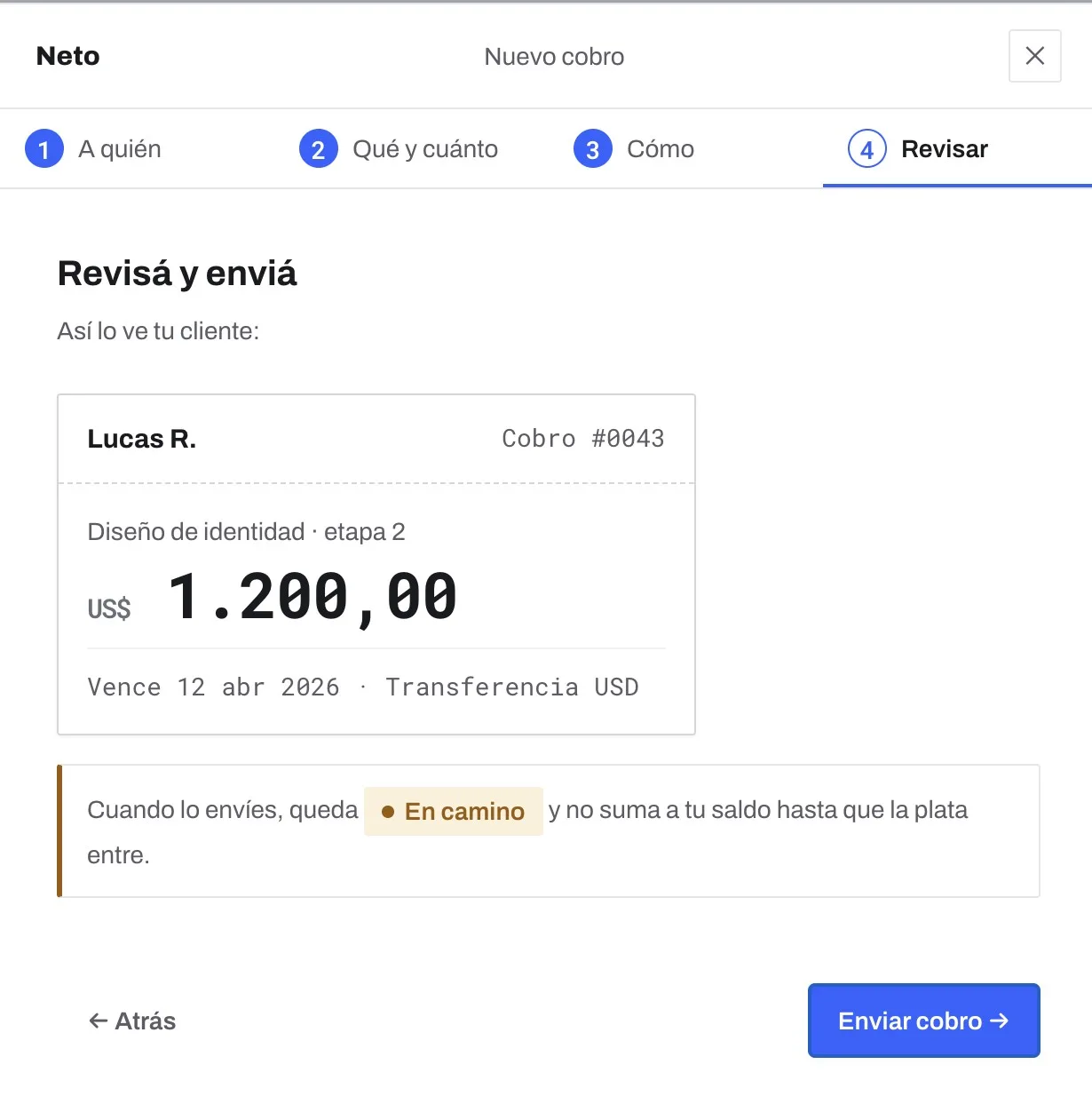
From those conversations I set one clear rule: money honesty. A charge that's been sent is not money until it lands, so Neto keeps "on the way" and "in" visibly apart, and never lets an optimistic forecast pretend to be cash. It turned into a few firm rules.
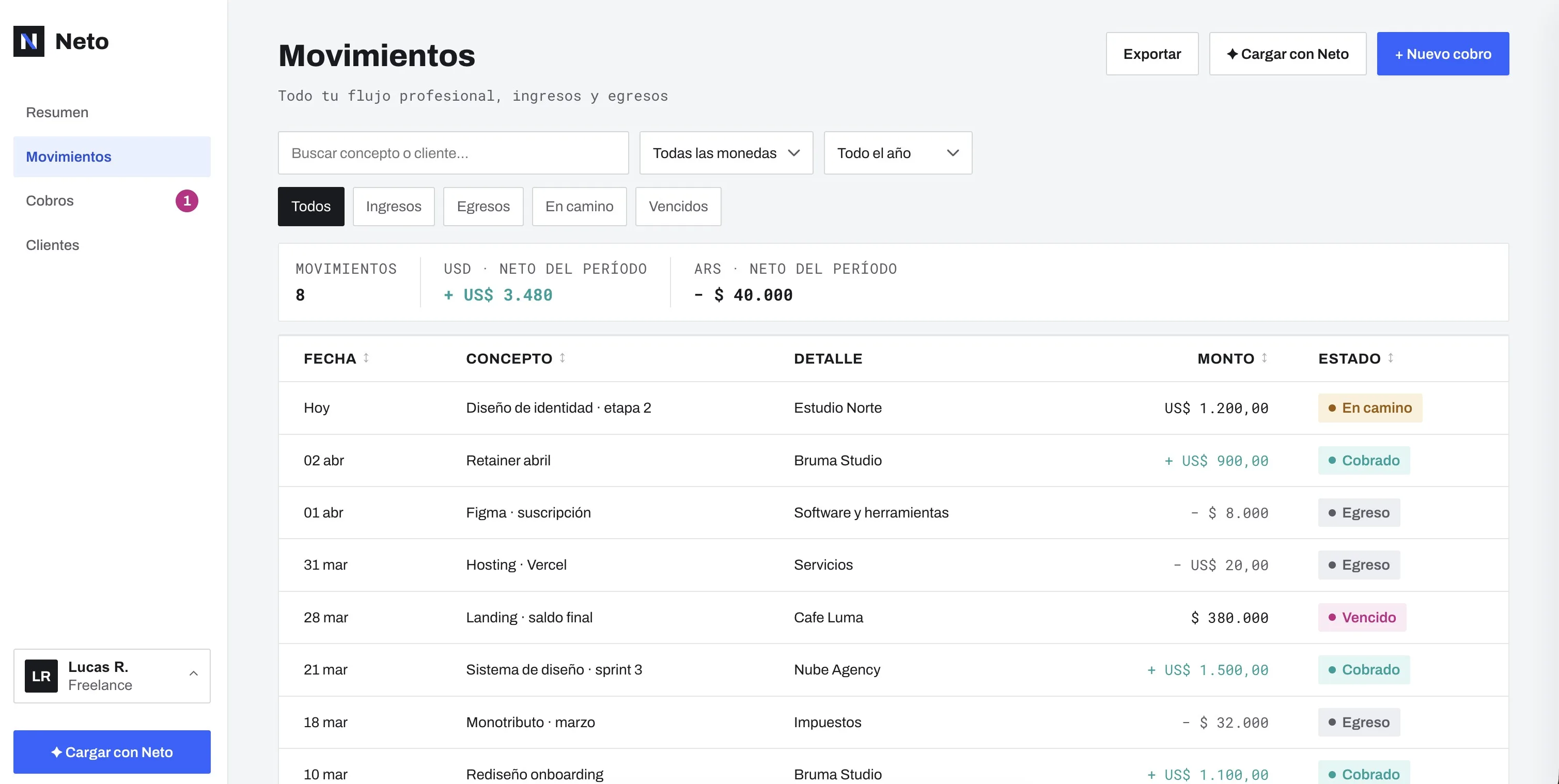
Currencies stay apart. Local currency, dollars, and USDT each get their own line. No consolidated total, because there's no honest one.
Work only. Income from clients and the professional expenses that make the work possible, software, hosting, taxes. The grocery run doesn't belong here.
Manual on purpose. No bank connections. Logging a charge is a small, deliberate act, which is exactly what makes the number trustworthy.
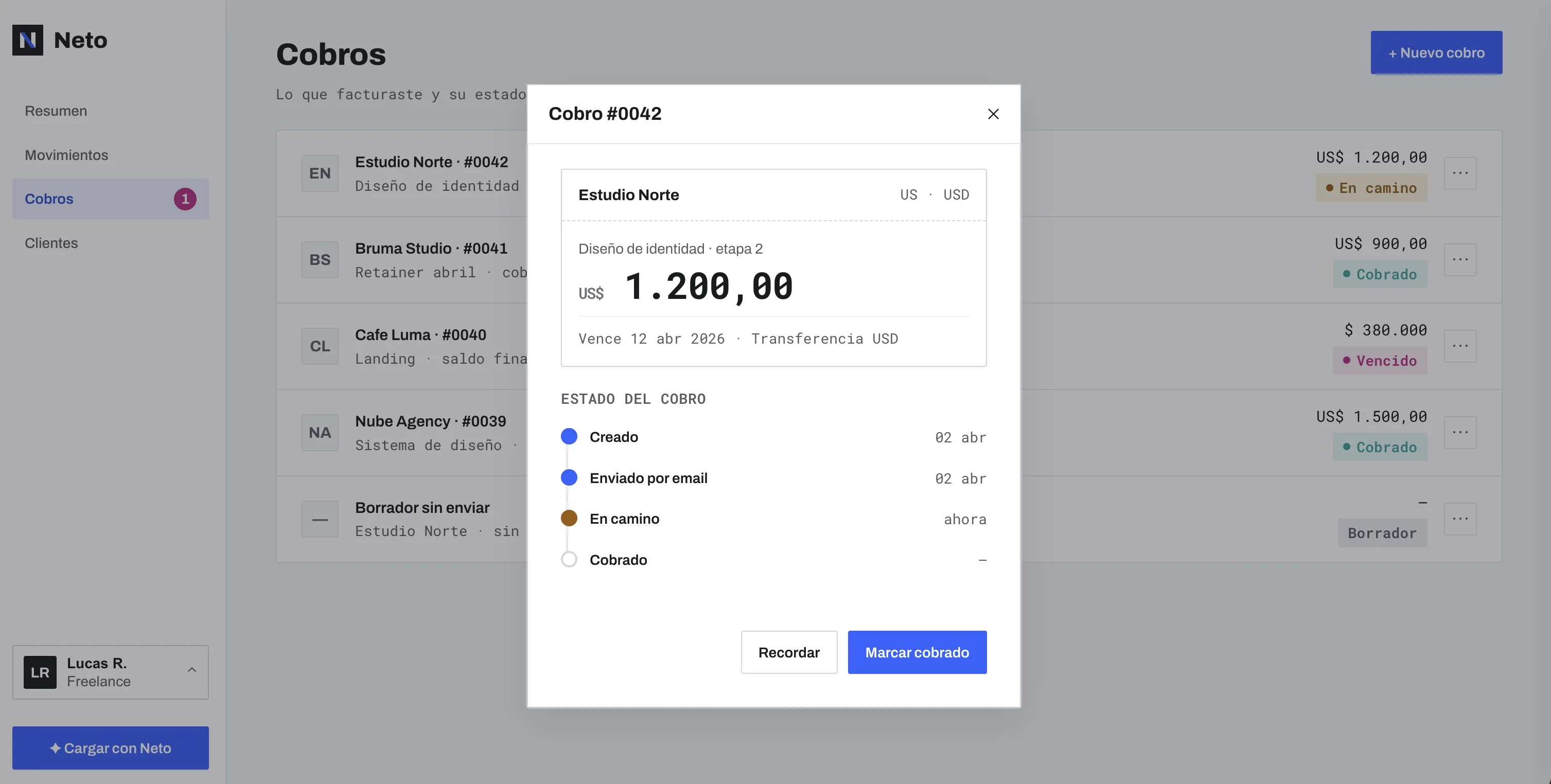
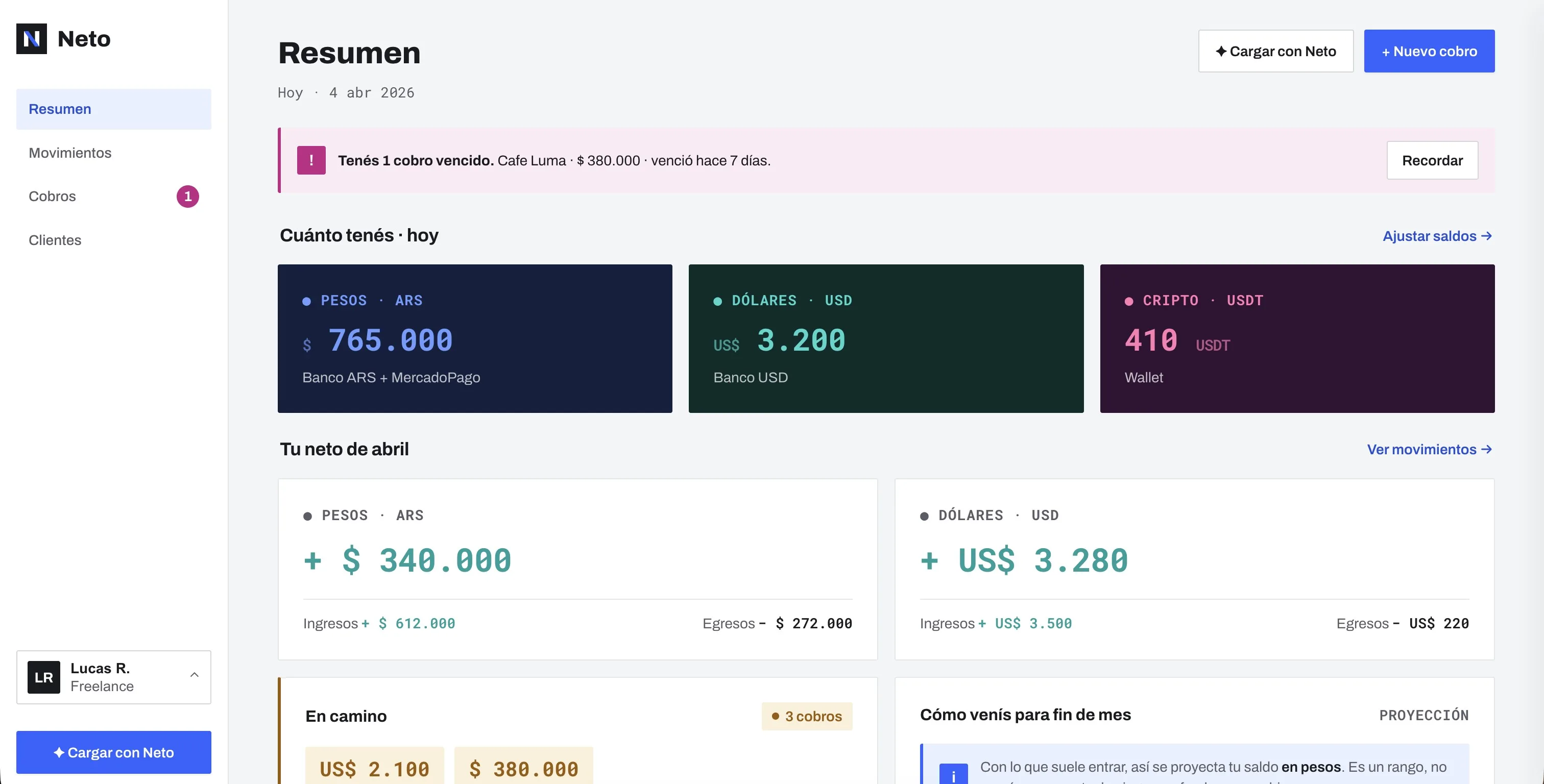
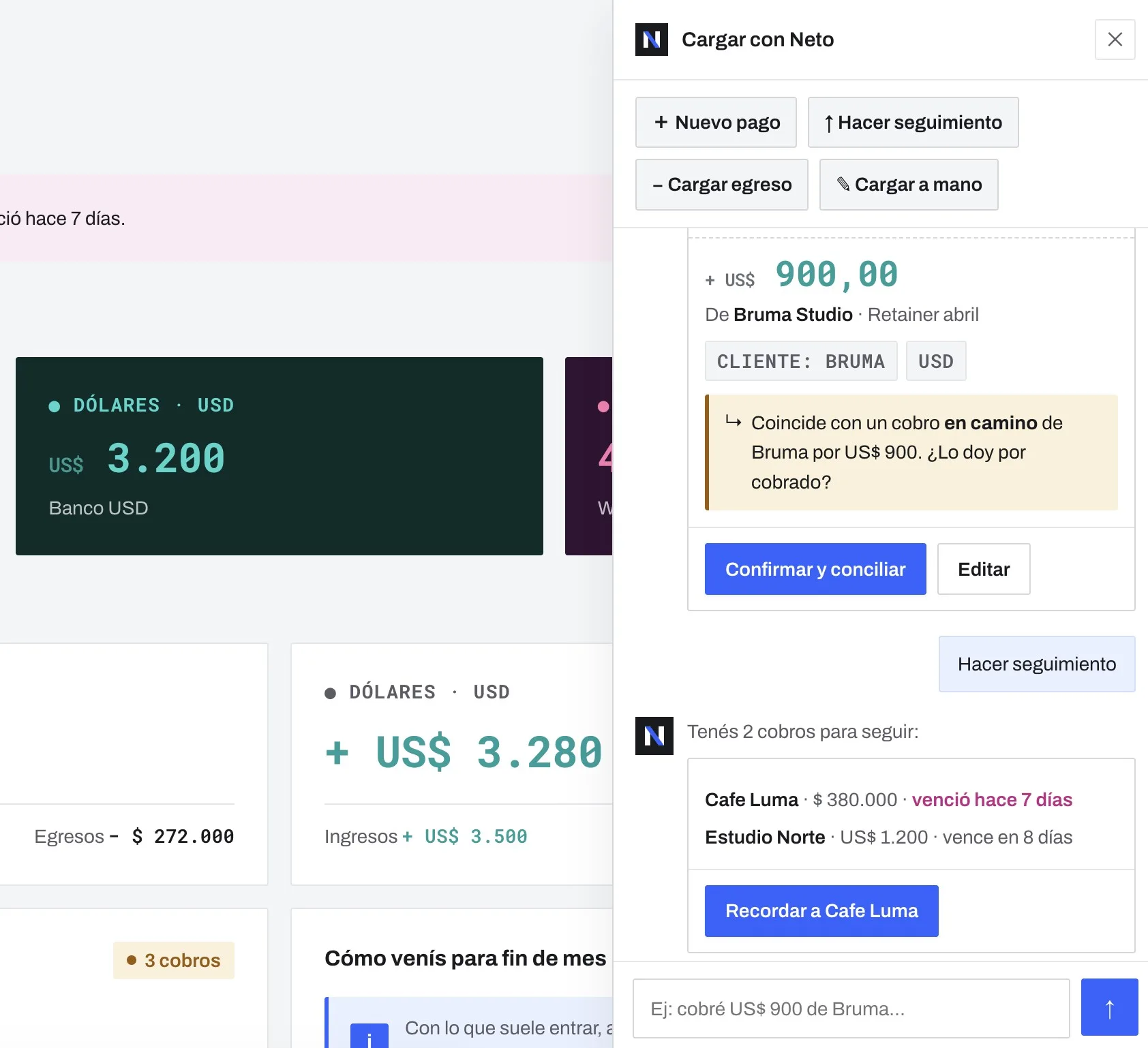
Neto is built around a single spine: a client, a charge, and what it adds to the month. The Summary opens on the net per currency, with an honest "on the way" for charges still pending. Movements lists income and professional expenses with filters. A guided charge wizard makes logging a payment a few clear steps, and a side capture chat lets you drop in a payment or an expense in plain language without leaving what you're doing.
I used Claude to prototype the idea, going from a written problem to a full, navigable interface without getting stuck on production before the concept was worth it. My frontend background meant I could push it like a real build, real states, real flows, real edge cases, not just pretty screens.
The visual language matches the honesty of the idea: everything square, hairline rules, shadows only where they help, and the numbers set in a monospace face so the money always lines up and reads like a receipt.


Neto was a chance to design purely from a point of view, no client, no brief, just a problem I understood in my own body and a principle I wanted to hold. The hardest calls were the subtractions: no consolidated balance, no personal finance, no bank sync. Saying no to the obvious features is what made the product specific.
It also showed me, concretely, how I want to work now. Using Claude to prototype the idea meant I could test the concept on its own merits, not on how long it took to draw. Working that way, paired with knowing how things actually get built, is the way I want to design going forward.
Nothing polished here, just the prototype doing what it does: reviewing a charge before sending it, logging through the chat, and marking money as collected once it actually lands.
That's how I want to design now: from a real point of view, prototyped for real with AI, and grounded in how things actually get built.